Central Kentucky ice storms have a way of finding the weakest point in a tree and exploiting it. More often than not, that point is a branch union — the fork where two limbs meet. Learning to read those unions before winter lets you address a hazard on a calm fall day instead of at 2 a.m. during an ice storm.
U-shaped good, V-shaped risky
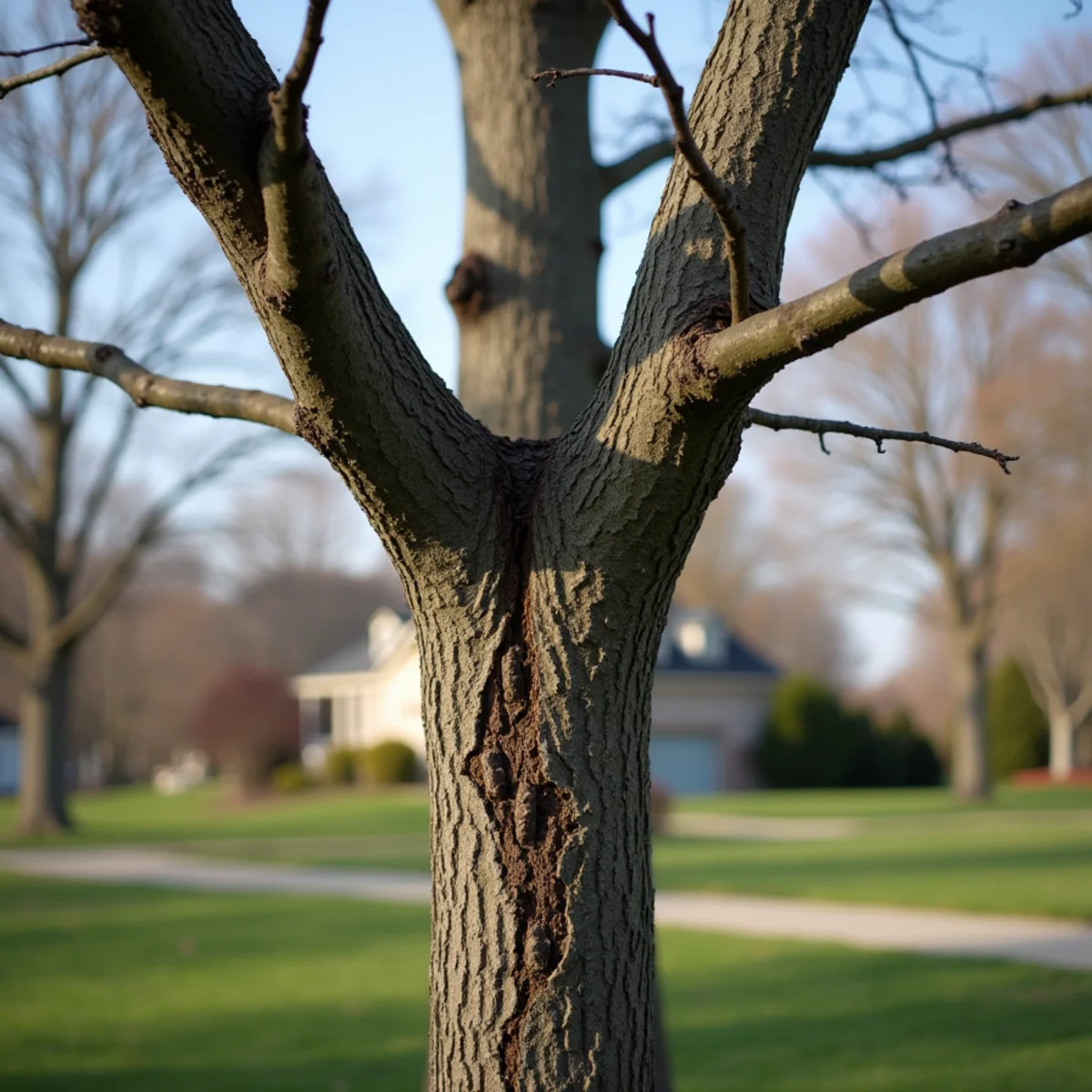
A strong branch union is U-shaped, with a rounded connection and a visible ridge of bark on top. A weak union is a tight V, where two roughly equal stems press together. In a tight V, bark often becomes trapped between the stems — called included bark — which prevents them from bonding into solid wood. That union has little strength and is the classic failure point under ice load.
What to look for from the ground
- Tight V-shaped forks, especially between two large, co-dominant stems.
- Bark that appears pinched or turned inward at the union rather than a raised ridge.
- Cracks or seams running down from the fork.
- Dead limbs, cavities, mushrooms, or soft, decayed wood near unions.
- Heavy, over-extended limbs that would carry a lot of ice weight.
What can be done about a weak union
You have options short of removing the tree. A high-value tree with a weak but otherwise sound union can sometimes be cabled or braced to support it. An over-extended limb can be reduced to lower the load it carries. And a limb that is already cracked or decayed should come out before it fails. The right choice depends on the tree, and it is worth a professional assessment.
Timing your inspection
Fall is the ideal time for this walk-through — the leaves are coming off, so the structure is visible, and there is still time to act before ice season. Make a loop around each big tree and look up. If something concerns you, a professional evaluation before winter is far cheaper than emergency removal and repair after a limb comes through the roof.
Field notes: what an arborist looks for that you can too
When we inspect a mature oak or maple before winter, the branch unions tell most of the story. A strong union is U-shaped with a raised ridge of bark on top; a weak one is a tight V where two stems press together and trap bark between them. That trapped, or included, bark means the stems never fused into solid wood — and that union is the classic failure point when an ice storm loads the canopy.
You do not need to climb to do a useful inspection. From the ground, look up: tight V-forks between co-dominant stems, cracks running down from a union, dead limbs, cavities, or mushrooms at the base signaling internal decay. Flag anything that concerns you and get it assessed before ice season, because addressing a weak union on a calm fall afternoon is a fraction of the cost of an emergency at 2 a.m.
The Bottom Line
Ice storms find the weakest union in a big tree — and you can usually spot it from the ground with a fall walk-around. Flag the tight V-forks and decay, and address them before winter. Hernandez Landscaping inspects and cares for mature trees across Scott County and Frankfort.
How Hernandez Landscaping Can Help
We put this into practice every day across Central Kentucky. Explore our professional tree service and cabling and emergency limb removal, or see how we serve Scott County properties and the Frankfort area.
Call (323) 606-0255Frequently Asked Questions
Often, yes. A valuable tree with a weak but sound union can sometimes be cabled or braced for support, and an over-extended limb can be reduced to lower its ice load. Already-cracked or decayed limbs should come out. An assessment determines the best option.
A yearly look, ideally in fall when the structure is visible after leaf drop, is a good rhythm for mature trees — plus a check after any major storm. Catching a weak union early is far cheaper than emergency removal and roof repair.
Often, yes. Cabling or bracing can support a valuable tree, and reducing an over-extended limb lowers its ice load. Already-cracked or decayed limbs should be removed. An assessment determines the best option.
Fall is ideal — the structure is visible as leaves drop, and there is time to address hazards before ice storm season.
Written by the Hernandez Landscaping team
We’re a locally owned, insured landscaping company that has designed, built, and maintained Central Kentucky properties since 2010. This guide reflects hands-on experience with Georgetown’s Zone 6b climate, clay soil, and freeze-thaw winters — not generic advice.
Sources & standards
Our recommendations draw on University of Kentucky turf guidance, EPA WaterSense irrigation principles, and USDA hardiness & soil data.