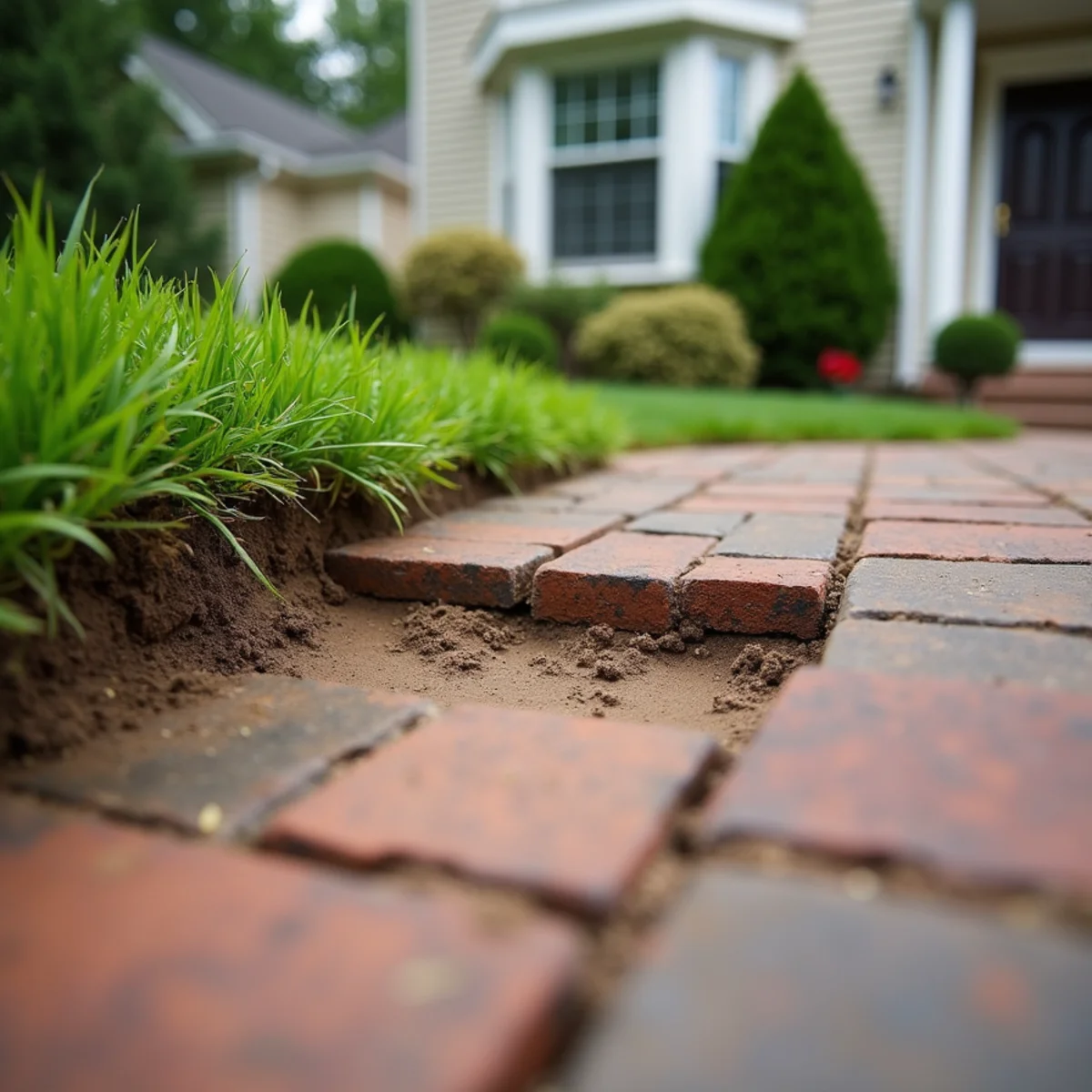
A patio or walkway that has developed dips, lifted edges, and wobbly pavers is one of the most common hardscape complaints we see. The frustrating part for homeowners is that the pavers themselves are usually fine. The failure is underneath — in the base — and in our heavy clay soil it is almost always preventable.
Clay soil is the setup
Kentucky clay holds water and swells and shrinks with moisture and temperature. If pavers are laid on a thin base, on top of undisturbed clay, or on a base that was never properly compacted, that movement telegraphs straight up to the surface. Add freeze-thaw cycles pushing the ground up and down all winter, and an under-built patio starts to come apart within a few seasons.
What a proper base looks like
- Excavation to the correct depth for the use — deeper for driveways than for a walkway.
- A geotextile fabric over the clay subgrade in many cases, to separate it from the base.
- Crushed aggregate installed and plate-compacted in lifts, not dumped in one layer.
- A screeded bedding layer for a true, level surface.
- Edge restraint to lock the field so pavers cannot spread and drift.
- Polymeric sand in the joints to keep them tight and stable.
Can sunken pavers be fixed?
Yes — but the fix addresses the base, not just the surface. We lift the affected pavers, rebuild the base to proper depth and compaction, correct the pitch so water sheds away, and re-lay the field. Simply adding sand under a low spot is a temporary patch that sinks again, because the underlying base failure is still there.
The lesson for a new project
When comparing patio bids, look past the paver style and ask about the base: excavation depth, compaction, and edge restraint. The base is invisible once the project is done, which is exactly why it is the first thing a low bid cuts — and the reason those patios fail.
Field notes: reading a failed patio
We can usually tell how a sinking patio was built by how it fails. Uniform dishing across a wide area points to a base that was too thin for the clay beneath it. Edges that have crept outward and opened up mean no edge restraint was installed. Localized dips near a downspout or low corner point to water undermining the base. Each pattern traces back to a specific shortcut, and each requires fixing the base, not just the surface.
That is the hard truth homeowners do not want to hear: you cannot lastingly fix a sunken paver by sweeping sand under it. The base failed, and the base is what has to be rebuilt — lift the field, correct the depth and compaction, restore the pitch, and re-lay. Done once, correctly, it stays put. Patched repeatedly, it keeps sinking because the cause is still down there.
The Bottom Line
Sinking pavers are a base problem wearing a surface disguise. Fix the layers underneath — depth, compaction, edge restraint, and drainage — and the patio stays true; patch only the top and it sinks again. Hernandez Landscaping rebuilds and installs patios that last across Georgetown and Winchester.
How Hernandez Landscaping Can Help
We put this into practice every day across Central Kentucky. Explore our brick and stone patio installation and residential hardscape design, or see how we serve homes in Georgetown and the Winchester area.
Call (323) 606-0255Frequently Asked Questions
If the pavers are in good shape, a localized base rebuild and re-lay is usually more economical than full replacement. We assess whether the whole field or just a section needs correction, and reuse your existing pavers wherever possible.
It depends on use — a walkway needs less than a driveway — but in our clay, a properly compacted aggregate base of several inches, often over a separation fabric, is what prevents the movement. The exact depth is set by the load and the site.
A localized base rebuild and re-lay is often more economical than a full replacement if the pavers are in good shape. We assess whether the whole field or just a section needs correction.
Not if the base is rebuilt correctly. The reason pavers re-sink is that only the surface was patched while the failed base was left in place.
Written by the Hernandez Landscaping team
We’re a locally owned, insured landscaping company that has designed, built, and maintained Central Kentucky properties since 2010. This guide reflects hands-on experience with Georgetown’s Zone 6b climate, clay soil, and freeze-thaw winters — not generic advice.
Sources & standards
Our recommendations draw on University of Kentucky turf guidance, EPA WaterSense irrigation principles, and USDA hardiness & soil data.